Wifi Hacking 101
Task 1 - Introduction of WPA
Key terms:
SSID: the network name that see when trying and connectingESSID: an SSID that can apply to multiple access points ⇒ bigger network. For Aircrack, they refer to the network is be attackingBSSID: an access point MAC (hardware) addressWPA2-PSK: wifi networks that connecting to by providing a pre-shared password that’s the same for everyoneWPA2-EAP: wifi networks that authenticating to by providing a username and password, which is sent to RADIUS serverRADIUS: a server for authenticating clients, not just for wifi
The core of WPA(2) authentication is the 4 ways handshake
1. The core
- Mutual Authentication: Both the Client and the AP prove to each other they know the password without actually revealing it
- Key Generation: Pairwise Transient Key (PTK) - a unique, one-time encryption key used to scramble your data for that specific session
The 4-WHS Process
Before this starts, both sides have already calculated a PMK using your password and ESSID
| Step | Direction | What happens? |
|---|---|---|
| Step 1 | AP → Client | The AP sends a random number called ANonce |
| Step 2 | Client → AP | The Client creates its own random number (SNonce) and calculates the PTK. It sends the SNonce and a Message Integrity Check (MIC)-a digital signature proving it has the right password. |
| Step 3 | AP → Client | The AP calculates the PTK using the SNonce. If the signatures match, the AP is convinced the Client is legit. It then sends the Group Temporal Key (GTK) for broadcast traffic. |
| Step 4 | Client → AP | The Client confirms that the keys are installed. From this microsecond forward, all data is encrypted. |
Note:
- PSK (Pre-Shared Key): the Wifi password
- ANonce: a random number generated by the Router (AP)
- SNonce: a random number generated by the Device (Client)
- PTK (Pairwise Transient Key): the encryption key for the data. It is calculated locally by both sides using: Password + ANonce + SNonce + MAC address
- MIC (Message Integrity Check): A digital signature used to verify that the password is correct and ensure the data hasn’t been tampered with
2. The role of the ESSID
In cryptography, a Salt is random data added to a password before hashing it. in WPA2, the ESSID acts as a Salt
The formular of the Master Key look as this:
\[PMK = PBKDF2(Passphrase, ESSID, 4096, 256)\]WPA2 vs the “Broken” WEP
| WEP (Wired Equivalent Privacy) | WPA2: |
|---|---|
| Used a static key, if gathering enough packets (statical analysis), the key eventually revealed itself cuz it repeated patterns | Used the 4-WHS to ensure that even if using the same password for 10 years, the PTK changes every single time which reconnect |
The Weakness of Offline Cracking
The hacker can capture all four packets of a successful handshake process and then they can run a Dictionary Attack offline ⇒ guess the password by brute force
Task 2 - Capturing packets to attack
The primary goal of this attack to capture the 4 - way handshake. And then we can attempt to crack the password by wordlist (brute force)
The aircrack-ng suite consists of:
- aircrack-ng
- airdecap-ng
- airmon-ng
- aireplay-ng
- airodump-ng
- airtun-ng
- packetforge-ng
- airbase-ng
- airdecloak-ng
- airolib-ng
- airserv-ng
- buddy-ng
- ivstools
- easside-ng
- tkiptun-ng
- wesside-ng
The aircrack tools come by default with Kali, or can be installed with a package manager or from https://www.aircrack-ng.org/
Step 1: Enable Monitor mode
By default, the NIC only “listens”, so enable monitor mode allow it can “sniff” every packet in the air
- Command:
airmin-ng start wlan0 - Key Detail: after running this, the interface name usually changes (wlan0 → wlan0mon). Should running
airmon-ng check killfirst to stop background processes that might interfere - Step 2: Network Reconnaissance
Scanning the area to identify the target network before and see who is connected to it
- Command:
airdump-ng wlan0mon
Step 3: Targeted Capture
Once we have the BSSID and Channel, we need to focus the NIC on that specific target to capture the handshake file
- Command:
airodump-ng -c [channel] --bssid [BSSID] -w [filename] wlan0mon - Purpose: telling card to stay on a channel and save all intercepted data into a
.capfile
Step 4: The Deauthentication Attack
Using Packet Injection to kick a current user off the network. Their device will automatically try to reconnect
- Command:
aireplay-ng -0 5 -a [BSSID] wlan0mon - Logic:
-0→ deauth attack, 5 → number of deauth packets sent
Step 5: Offline Cracking
Using CPU/GPU to compare the handshake against a list of possible passwords
- Command:
aircrack-ng -w /urs/share/wordlists/rockyou.txt [filename-01.cap]
Task 3 - Practice
The task file for practice can be downloaded from the provided
After downloading and extracting the archive, five different files are obtained, as shown in the figure like this
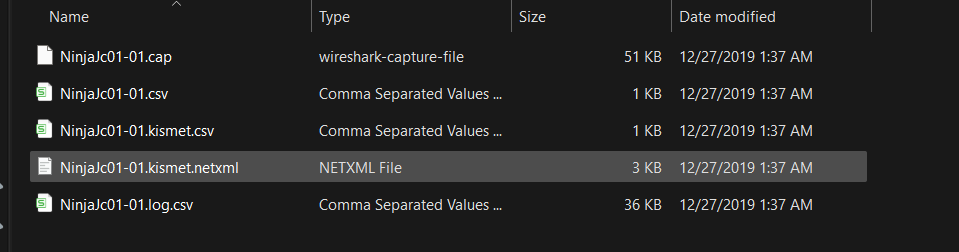
In this task, we focus on the file NinjaJc01-01.cap, while the remaining files contain reconnaissance logs
The analysis is performed using Ubuntu on Windows via WSL. To crack the captured handshake, the following command is used:
aircrack-ng -w [path_to_rockyou.txt] [path_to_NinjaJc01-01.cap]
After a few seconds, Aircrack-ng successfully recovers the WPA password
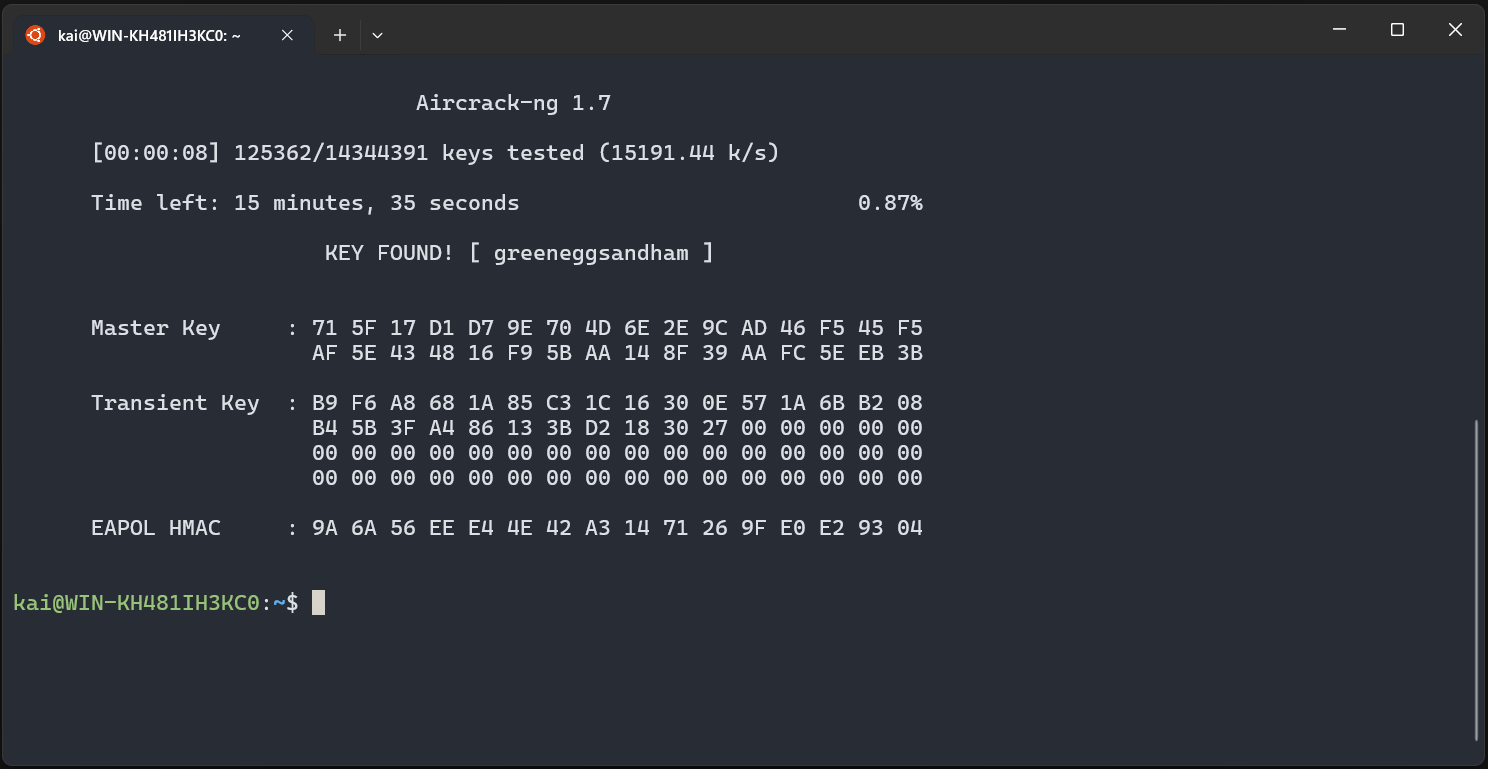 The cracked password for the network “James Honor 8” is:
greeneggsandham